About Rod Buntzen
A Navy scientist who now paints, sculpts and writes.
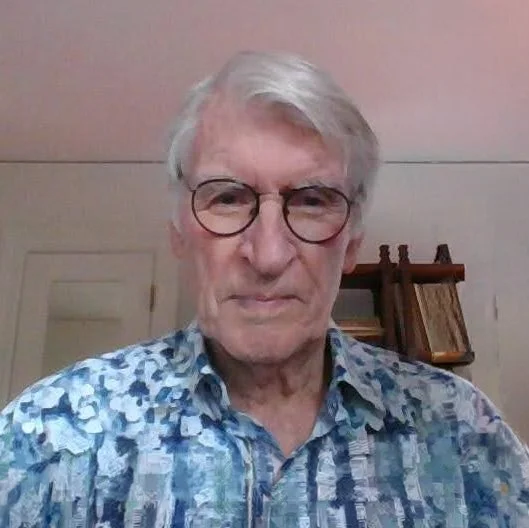
Bio
I was a UC Berkeley student in 1958 working part time in research and development for the US Department of the Navy when I participated in nuclear weapons tests in the Pacific Proving Grounds. When my laboratory closed in 1967, I continued research work at the Naval Undersea Center in San Diego for another two decades before joining a small high-tech company designing advanced sensor and weapon systems for the US Navy. I retired from R&D in 2002.
My current books are 1501 - Leonardo and Michelangelo in a Tale of Art, Love, and Betrayal, and The Armageddon Experience.
Now, I paint and sculpt to explore the boundaries that exist between representational and abstract content in visual art. My works contain both abstract and representational color and sculpture (form) that lead a viewer to the meaning and understanding I intended. I also write about subjects of interest and life experiences from the long career with the Navy. My work takes place in an imaginary space I call a Word, Color, and Form Studio. Some works are shown in the examples below.
In His Own Words
“When the last witness to nuclear Armageddon is gone, the temptation to create others will become irresistible.’ – Rod Buntzen, The Armageddon Experience, 2019.
“Today’s society is so much removed from the Cold War days that I am not sure many people care much about the possibility of nuclear war. Politics and climate change dominate the news.”
– Rod Buntzen, 2019 Pacific Book Review, The Armageddon Experience. Is it still true today?
“A painting requires both representational and nonrepresentational content to become art … each is necessary, but not sufficient by itself to define art.”
– Rod Buntzen, from the essay “Abstract Art or Abstract Painting,” 2015
“A work becomes art when the viewer is challenged to find the artist’s message.”
– Rod Buntzen, from the essay “Abstract Art or Abstract Painting,” 2015
Words
I awoke many mornings during my career to an exciting world of wonder and purpose. As a government applied research scientist, I enjoyed access to defense research closed to most industrial, academic, and allied scientists, which provided uncommon opportunities to communicate with some of our country’s most creative technical minds. My experiences ran a venue gamut of arctic cold, desert heat, high altitude, and on and beneath the ocean, often in unusual foreign settings, but always with a clear mission. Each new day offered a research challenge, and, on some days, my mind ventured into new technical worlds not yet explored. On many mornings I rushed to work to continue solving problems begun in the night’s darkness that lay between periods of sleep.
Early in my career, I realized that I had to know whether my research had a moral cost. I quickly perceived that it does. In The Armageddon Experience, I described an experiment to find out whether I could improve the effects of an underwater nuclear weapon. Luckily, it turned out to a naive idea, but the emotional damage was done. It showed me that my curiosity could be a powerful drug, luring me to places I did not want to go. In my new memoir Techno-Warrior, I avoid nuclear issues and focus on tactical defense applications of advanced technology. I would also like to see my screen manuscript turned into a screen or theater production.
Color
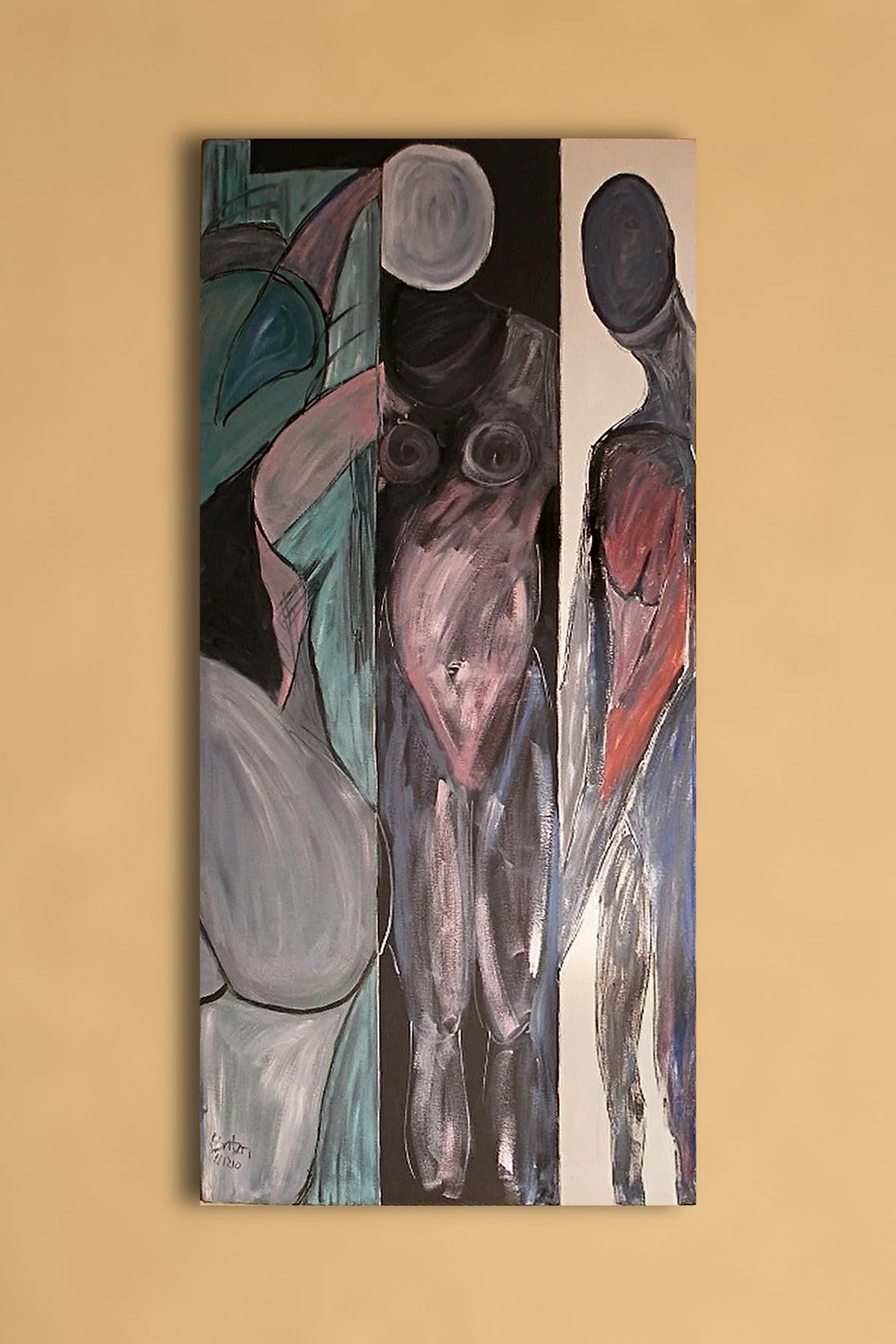
Graces
The canvas is an example of an “internal” triptych of separate images placed in a single frame. Euphrosyne, showing merriment by dancing, is the most abstract figure and can be difficult for some viewers to unambiguously recognize as the female form when viewed separately. Aglaea, the beautiful, and Thalia, the charming, are placed on individual negative spaces. Together the three figures complete the notion of connected intent, while their number leads to the possibility that they represent a well-known icon such as the “Three Graces”.
Form
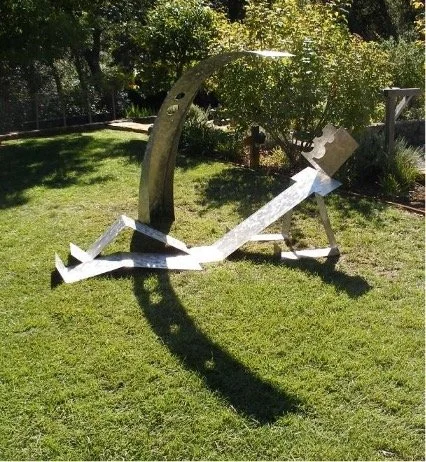
Copernicus Unbound
The astronomer Nicolaus Copernicus appears as a reclining figure, gazing skyward through an abstract curved object containing a line of holes. The holes have diameters that are scaled to the relative sizes of the planets and their spacing is scaled to their relative distance from our sun. The figure of Copernicus has an intentional facial expression that suggests surprise at realizing that the earth is not the center of the solar system. Copernicus is reclining to observe the line of sunlight projected on the ground through the holes, which act as a sun dial. As the sun moves through the sky, the projected spots on the ground can tell the time of day when it is calibrated.
Coming Soon
Techno Warrior: A Career in High-Tech Defense Research
Coming late 2026
The book is a narrative memoir that takes the reader deeper into the Cold War advanced technology programs reported in newspapers and magazine. Some of the science being developed in that period is becoming real today in the defense against drones and fusion energy production. Most of the technologies fell to the junkyard and await future research.
Moving beyond nuclear weapons testing experience, the book weaves laser development for weapons, fusion energy research, electron beams for ship defense, nonacoustic sensor submarine detection, and hyperspectral surveillance into the modern defense world anticipated to meet today’s threat from Russia and China.
Kirkus Reviews, March 2026:
“an arresting professional autobiography that’s both scientifically and historically instructive.”
Rod is also publishing a screenplay for
“1501- Leonardo and Michelangelo in a Tale of Art, Love, and Betrayal”
“The period, the characters, and their competitive nature could never be contained in the pages of a book.”